Classical statues were not painted horribly
62 comments
·December 18, 2025Geonode
pantalaimon
That's what TFA is saying
> Another may be that they are hampered by conservation doctrines that forbid including any feature in a reconstruction for which there is no direct archaeological evidence. Since underlayers are generally the only element of which traces survive, such doctrines lead to all-underlayer reconstructions, with the overlayers that were obviously originally present excluded for lack of evidence.
griffzhowl
Yes, this is what tfa says, and it's a good point. But tfa also points out that the archaeologists/reconstructionists know that what they're producing differs from the original. The thing is the discipline of reconstruction means that they only use pigments that they have direct evidence of, and this is just the saturated underlayers. The problem is this is seldom explained when the reconstructions are presented to the public
marginalia_nu
Yeah, I've likewise always figured the reason these reconstructions ended up looking so awful is because paint is generally applied in layers (even to this day), so what they're likely reconstructing is the primer layer.
Like we know from Roman frescoes[1] and mosaics[2] that they were pretty skilled painters and solving the problem of how to paint something to have more hues than a King's Quest 3 sprite is unlikely to be an unsolvable aesthetic problem.
[edit] Changed from Secret of Monkey Island since that game has too many versions and remakes.
[1] https://upload.wikimedia.org/wikipedia/commons/6/6e/Chiron_i...
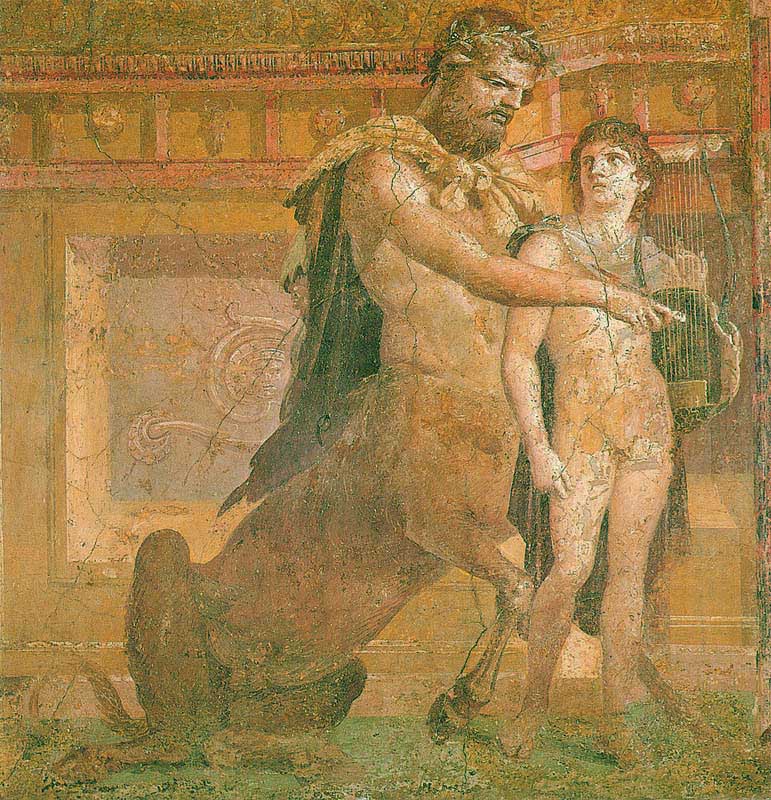
[2] https://en.wikipedia.org/wiki/Plato%27s_Academy_mosaic#/medi...

fsloth
"many people are operating outside their area of expertise on this subject."
Exactly. I takes years of really hard work to get good at this stuff. Decades.
I do realize research budgets are not that awesome, but when claims are of aesthetic in nature (explicitly and implicitly) and deal with human craftmanship there should definetly be collaboration with also craftsmen subject experts.
A good example where this was executed really well was the Notre Dame reconstruction (I _guess_). Craftsmen and academic diligence hand in hand.
Not everyones archeological reproduction has such a budget unfortunately.
the_af
> I do realize research budgets are not that awesome, but when claims are of aesthetic in nature (explicitly and implicitly) and deal with human craftmanship there should definetly be collaboration with also craftsmen subject experts.
Do we know for a fact this didn't happen in this case?
johndhi
Makes sense. This is basically how skilled painters of miniatures (Warhammer) do it.
ActivePattern
I assume you didn't read the article, since that's their exact point...
"Since underlayers are generally the only element of which traces survive, such doctrines lead to all-underlayer reconstructions, with the overlayers that were obviously originally present excluded for lack of evidence."
boxed
Maybe it's the author of the article? :P
empath75
Even a middling warhammer miniatures painter would have done a better job of painting these statues than the reconstructions.
mikkupikku
Makes me wonder if they ever used the same sort of gimmicky paint, like paint with mica flakes to make something look metallic.
buescher
I think the best explanation is that classicists are not makeup artists. I am reminded of reading some classicists' attempt to create garum in the kitchen by making some unpleasant horror of mashed fish or something back in the eighties or nineties. No one ever mentioned in those kinds of write-ups back then that they still make fish sauce in Italy. (I looked for the source I'm thinking of and it's drowned out by more credible modern attempts). There's a tendency the further north you go to think of the classical world as completely lost, discontinuous, and opaque to us, too, which adds to it.
AdmiralAsshat
> I am reminded of reading some classicists' attempt to create garum in the kitchen by making some unpleasant horror of mashed fish or something back in the eighties or nineties. No one ever mentioned in those kinds of write-ups back then that they still make fish sauce in Italy.
A more modern example might be that recently discovered Babylonian Lamb Stew [0]. Most of the scholarly reconstructions of the stew follow the recipe very literally, and the result is, frankly, awful, because ancient readers would probably have made cultural assumptions about certain steps in the recipe. Meanwhile, some internet cooks who take a stab at the same recipe come up with something arguably much better, because they're applying their knowledge as cooks to guess what might have been stated or unstated by the recipe. [1]
Makes you wonder why no one thought to just take a copy of one of the statues to a modern artist and say, "Hey! How would you paint this?" I'm willing to bet that, even now, it would be reasonably close to how an artist 2000 years ago might have approached it.
[0] https://eatshistory.com/the-oldest-recorded-recipe-babylonia...
[1] https://www.tastinghistory.com/recipes/babylonianlambstew
emursebrian
Fish sauce is also really popular in southeast Asia and Worcestershire sauce is often made with fermented fish so can also be considered garum adjacent.
buescher
There's speculation that Asian fish sauce came from Greece through the same cultural diffusion processes that brought Greco-Buddhist sculpture as far as Japan.
marginalia_nu
There's even a case that Ketchup is a distant relative, as it started out as South East Asian oyster sauce, was imported to Europe, turned into fermented mushroom sauce, was exported to the colonies, and finally turned into tomato sauce (though originally sometimes with fish in it).
null
numlocked
Good read! The idea that these marvels of artistry were painted like my 10th birthday at the local paint-your-own-pottery store always seemed incongruous, at best.
> Why, then, are the reconstructions so ugly?
> ...may be that they are hampered by conservation doctrines that forbid including any feature in a reconstruction for which there is no direct archaeological evidence. Since underlayers are generally the only element of which traces survive, such doctrines lead to all-underlayer reconstructions, with the overlayers that were obviously originally present excluded for lack of evidence.
That seems plausible -- and somewhat reasonable! To the credit of academics, they seems aware of this (according to the article):
> ‘reconstructions can be difficult to explain to the public – that these are not exact copies, that we can never know exactly how they looked’.
bluGill
One issue: the paints/pigments available in times past were not the full range we have today. Sometimes they had to make things somewhat ugly to both our and their taste because that is all they have available. They would still have done their best, but there are limits.
We are hampered even more today because blues and greens tend to be sourced from organic materials that decay quick, while reds and browns are from minerals that don't decay (but flake off). Even in the best preserved art that we have there is still likely significant differences between what we see and what they saw because of this color change.
fwipsy
This is true, but it wouldn't produce the sort of flat coloring in the reproductions. It would limit the color space but artists could still blend and fade those colors to create intermediate tones. This is demonstrated in some of the beautiful ancient murals which the article uses for comparison.
null
mc32
Another thing is they may have wanted to use newly available colors to show they had new colors. Kind of like when people learned to make aluminum it was sought as a luxury item —whereas now no one would think of aluminum as a luxury item.
dv_dt
It seems a shame that there is a gap between the limits of what is possible to deduce from direct evidence, and what is likely possible given human ability. And further that the public viewing the reconstructions doesn't take away the subtleties of the difference. To me it's unlikely that some of these works weren't vastly better works of art created by what were likely master artists and craftsfolk of the day.
One way to close that gap would be to offer interpretations to be painted by modern artists to show what was possible and a viewing public could view a range of the conservative evidence based looks, and maybe a celebration of what human artistic ability can offer.
empath75
It's the same problem with trying to reconstruct dinosaurs, with probably the same solution in terms of public communication -- producing a _range_ of possible reconstructions based on the available evidence.
That said -- I think we actually do have more indirect evidence than what the reconstructions used -- in fact 3 separate lines of evidence A) paintings of statues B) contemporary descriptions of statues and C) contemporary paintings in general. All of which suggest that the coloring would have been more subtle and realistic.
I think if we had contemporary paintings of dinosaurs with feathers and contemporary accounts in writing that dinosaurs had feathers, but no feathers in the fossil record, you would still be fairly justified in saying that dinosaurs probably had feathers.
sdenton4
If only there were some system that could start from some sparse and noisy observations and weave together a plausible completion...
ijk
Interestingly to me, generative AI is often used to get results that commit the opposite error compared with these statues: they are, essentially, too confident in their choice of details. For any random topic, the average member of the public is likely to believe the AI's results are more accurate than can be backed up by the evidence.
dbdr
Generative AI exists, but it is very much dependent on the data it has been trained on. Not saying it would not be interesting, but a huge caveat is required.
dv_dt
I would much rather see human artist interpretations after they were briefed by the archeological experts on the evidence.
the_af
> If only there were some system that could start from some sparse and noisy observations and weave together a plausible completion...
Humans?
rob74
> But they fail to correct the belief that people naturally form given what is placed before them: that the proffered reconstruction of ancient sculpture is roughly what ancient sculpture actually looked like.
I'm pretty sure many museums with reconstructions of classical statues have a note on this topic somewhere on a plaque beside the statues - but who reads those?
rwmj
His final conclusion is terrible and spoils an otherwise excellent article. Unless he has really strong evidence of it, the specialists are very unlikely to be "trolling" the public. They are scientists and conservators doing their best, working away in museum backrooms.
wongarsu
"trolling" in this instance seems to be a nicer way of saying "misleading to create attention". It's hard to deny that "look at how garish these beautiful statures originally looked" created a lot more attention than a theoretical "Roman statues looked pretty nice, but with paint"
It's an unsubstantiated theory, but the author does go out of their way to say that this might not even be objectionable, if it happened at all
boxed
It could be survival bias trolling: those who accidentally troll get attention, not understanding that they are trolling.
chrismatic
Even worse so: Why does he not simply ask these people? What is it with this trend of sneering at expert decisions without even doing the bare minimum of engaging with them?
ericmay
In the case of the humanities, art, or architecture in academia if you disagree with the orthodoxy you might end up labeled something you don’t want to be labeled as, and you don’t get very far.
In architectural design I think it’s rather pronounced. We already know how to design great buildings for the human environment. There ain’t anything new to learn here, so in order to stand out in the field you have to invent some bullshit.
Well, you do that, you create Brutalism or something similarly nonsensical, and in order to defend your creation you have to convince a lot of other academics that no, in fact, buildings that look like bunkers or “clean lines” with “modern materials” are the pinnacle of architecture and design.
And as time has gone on we still go and visit Monet’s Gardens while the rest of the design and art world continues circle jerking to ever more abstract and psychotic designs that measurably make people unhappy.
Not all “experts” in various fields are weighted the same. And in some cases being an expert can show you don’t really know too much.
skybrian
Yes, it’s speculating when it would have been better to do some journalism and ask some experts what they were doing.
mopsi
> They are scientists and conservators doing their best
Even if tastes have indeed changed, something that matches our current taste will reproduce the impact of the statues better than a scientifically meticulous and factually accurate depiction that misses the emotional truth.
the_af
> Give them the tools that were available at the time and let them do their best.
The end result would surely look better, but how would we be assured it resembled historical reality?
Do we know for a fact in these reconstructions there is no input whatsoever from artists? I know, for example, that paleo-artists are responsible for the reconstruction of what dinosaurs are currently thought to have looked like, and they are mostly artists that work in collaboration with scientists directing their work. Why do we think this is not the case for the reconstruction of colors of Roman statues?
andrewl
One idea of how ancient statues might have been colored can be seen on the pediment of the Philadelphia Museum of Art:
https://commons.wikimedia.org/wiki/File:Pediment,_Philly_Art...
.jpg)
null
johndhi
This is fun though I sort of wonder if it's attacking a straw man. Are there any reconstruction folks who defend these?
esperent
I've literally never heard anyone say that classical statues were painted "horribly", and unless I missed it, there's no sources in this article that say that, either (just several links to the same New Yorker article talking about whiteness).
What I've always heard is that classical statues were painted "brightly".
So, is this something that's so well known in the study of antiquities that no source was required, or has the author just got a personal bugbear here?
qsort
I believe the argument isn't that ancient statues were ugly, but rather that reconstructions are ugly (unfortunately this has been used to argue against the now ascertained fact that ancient statues were indeed painted). Purely subjective judgement from someone not trained in the arts: that photo of the Augusto di Prima Porta doesn't look like a great paint-job. The idea that, like the statue itself, the painting must instead have been a great work of art lost to time seems solid to me.
sebastianmestre
I think the pictures of the reconstructions are source enough, they look horrible
pmichaud
It made immediate sense to me, since the painted statues do, in fact, look gaudy and horrible. I think he was evoking a widely held feeling that is bot in common knowledge.
null
DuperPower
Loved the article, the author is a smart person to doubt the changing taste hypothesis, I think everything based on "we are smarter and have better taste that the ancients" have to be extremely doubted, knowing we, the west, are the same society since the romans is so humbling
I will die on this hill, because I'm right. Painters put on the first layer in saturated colors like this, then add detail, highlight and shadow. The base layer stuck to the statues, and the rest was washed away.
This whole thing just won't go away because many people are operating outside their area of expertise on this subject.
Painters layer paint, starting with a saturated base color. These archaeologists are simply looking at the paint that was left in the crevices.